Play vs. Real Fighting in Cats: The Illustrated Body Language Guide
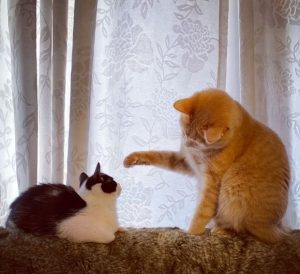
The pouncing, the rolling, the bunny-kicks—it can look terrifyingly similar to a real fight. Misreading play as aggression can lead you to unnecessarily interrupt healthy social bonding. Misreading real aggression as play can lead to injury and lasting trauma. The difference isn’t in the actions themselves, but in the silent language that surrounds them: the position of an ear, the flick of a tail, the tone of a vocalization.
This illustrated guide is your decoder. We’ll break down the critical signals, side-by-side, so you can confidently answer the question: “Are they playing or fighting?” and know exactly when, and how, to intervene.
The Golden Rule: Read the WHOLE Conversation
Never judge by a single action. Synthesize Ears, Eyes, Tail, Body Posture, and Vocalizations. A single bite can be playful; the context tells you if it’s a problem.
🐱 The Face & Head: The Mood Ring
Ears
-
Play: Ears are generally forward or relaxed, like satellite dishes taking in fun. They may swivel playfully.
-
Real Fight: Ears are flattened sideways or pinned back against the head (“airplane ears”). This is a clear sign of fear, defense, or offensive aggression.
Eyes & Gaze
-

Happy eyes! Play: Pupils may be dilated from excitement, but the gaze is soft, blinking, or glancing away. There are breaks in eye contact.
-
Real Fight: Hard, unblinking staring. This is a direct challenge. Pupils are often fully dilated (black pools) from adrenaline, even in good light.
Whiskers
-
Play: Whiskers are forward or to the side, relaxed.
-

The whiskers say,”Not a good day for me.” Real Fight: Whiskers are pulled back tightly against the face, making it look narrower and more defensive.
🐈 The Body: The Posture of Intent
Body Tension
-
Play: Bodies are loose, bouncy, floppy. Movements are exaggerated and sometimes clumsy.
-

Some coiled muscles here. Real Fight: Bodies are stiff, tense, close to the ground. Every muscle is coiled for offense or defense.
Claws
-

Claws are out. Be careful. Play: Claws are sheathed. You might see soft paw-swats.
-
Real Fight: Claws are out. This is a serious weapon.
Biting
-
Play: Bites are inhibited—no pressure, no broken skin. It’s a “mouthing.”
-
Real Fight: Bites are hard, forceful, and intended to harm. You may hear a painful yelp.
🐈⬛ The Tail: The Emotional Barometer
-

Tail is straight up meaning more confident than a used-car salesman. Play: The tail is often up in a friendly question-mark or loosely swishing. It may gently thump the ground in focused arousal.
-
Real Fight: The tail is lashing violently, thumping hard, or puffed up like a bottle brush. A low, tucked tail indicates fear.
🔊 The Soundtrack: Playlist vs. Alarm
-
Play: Mostly silent. You might hear the occasional chirp, trill, or a brief squeak if play gets too rough.
-
Real Fight: The soundtrack of hissing, growling, yowling, and screaming. These are distress and threat vocalizations.
🔁 The Rhythm: The Dance of Engagement
-
Play: Role Reversal. The cat on top switches to the bottom. There are natural pauses where cats break apart, shake off, or look around before re-engaging.
-
Real Fight: One-sided. One cat is consistently the aggressor, the other the defender. It’s continuous and intense with no breaks. The goal is to make the other cat flee or submit.
🧐 The Aftermath: The Cool-Down
-

No tension here. All cats are cool. Play: Cats separate calmly. They may groom themselves, wander off to eat, or simply lie down near each other. No lingering tension.
-
Real Fight: Cats bolt apart and hide. They avoid each other, may continue to hiss or glare from a distance. The air feels tense for hours.
🛑 When to Intervene: Your Action Guide
Let play continue if: Bodies are loose, ears are forward, it’s quiet, and they take breaks.
Intervene IMMEDIATELY if you see/hear:
-
Pinned ears, hissing, growling, or screaming.
-
A cat trying to flee but being chased/blocked.
-
A clear size/power imbalance where one cat is overwhelmed (the “victim” stops playing and just tries to get away).
-
Use safe interruption methods: Make a loud noise, toss a pillow nearby, or use a barrier. Never use your hands.
Conflicts often arise when cats have incompatible interaction preferences, a dynamic explained in managing play style mismatches between cats.
🩺 When “Rough Play” is a Problem
Even play can be problematic if:
-
One cat is always the instigator and the other is reluctant.
-
Play consistently escalates until one cat cries out.
-
It happens at night, disrupting sleep.
-
This is often a play style mismatch requiring management. See our guide on Managing Gentle Giants vs. Timid Souls.
When toys become a source of tension instead of fun, you may be dealing with toy possessiveness and play-based aggression in cats.
Conclusion: Becoming a Fluent Observer
The line between play and fighting is drawn in the subtleties. By learning this language, you move from an anxious guesser to a confident observer. You can protect your cats from real harm while allowing them the vital, joyful exercise of social play. Your home becomes safer because you understand the conversation happening right in front of you.
This skill is foundational. Use it to inform all other protocols. For next steps after a real fight, see our guide on Safe Intervention & Reintroduction. To deepen your knowledge, explore our complete Aggression & Bullying Hub.